
Why the future of industrial drone operations is not about flying more missions, but about building autonomous capabilities into everyday operations.
From Occasional Flights to Permanent Operational Capabilities
For many organisations, drones are still considered tools deployed for specific missions.
An inspection is required. A pilot prepares the equipment, travels to the site, conducts the flight and processes the collected information.
This approach has demonstrated the value of unmanned aerial systems across industries, from infrastructure inspection to security and asset monitoring.
However, it also introduces operational limitations.
Each mission requires preparation, personnel availability and coordination. Data collection may remain dependent on scheduled interventions rather than actual operational needs.
As industrial environments become more connected and automated, a different model is emerging.
What if drones were no longer treated as occasional inspection tools, but as integrated components of an organisation's operational infrastructure?
This represents an important evolution in how autonomous technologies can create value.
The Emergence of Drone-in-a-Box Infrastructure
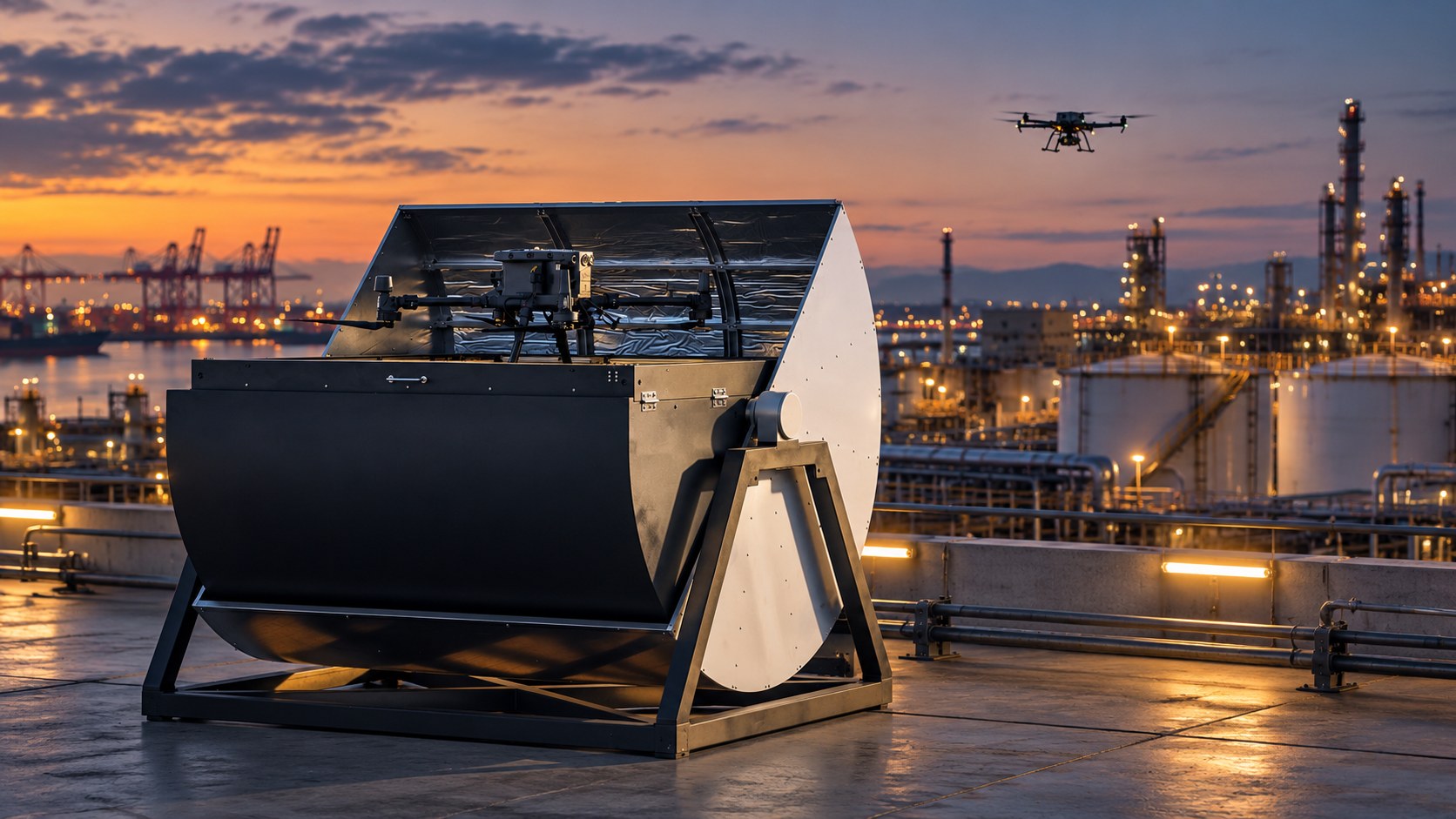
Drone-in-a-Box (DIAB) systems combine an unmanned aircraft with a fixed docking station designed to support repeated missions.
Depending on the technology, the station may provide protected storage, automated landing, battery charging or exchange, and connectivity with remote management platforms.
The drone can be configured to perform scheduled or event-driven operations within an approved operational framework.
Potential applications include:
- Routine inspection of industrial facilities and infrastructure.
- Perimeter monitoring and security patrols.
- Verification of alarms or reported incidents.
- Monitoring of construction, logistics and storage areas.
- Environmental observation and infrastructure condition assessment.
The advantage is not simply that the drone can launch from a fixed station.
It is that aerial data collection can become part of a repeatable operational process.
The Real Value Begins After the Flight
An automated flight does not automatically produce operational value.
A drone may collect hundreds of images without helping an organisation understand what has changed or what requires attention.
To become genuinely useful, drone infrastructure needs to connect with the systems responsible for managing industrial operations.
Consider an industrial facility where a security alarm is triggered near a remote section of the perimeter.
An integrated system could initiate an authorised drone inspection, transmit live imagery to a security operator and associate the observation with the original alarm.
The operator would then have additional information to support an appropriate decision.
Similar workflows could be developed for infrastructure inspection, asset monitoring and maintenance.
The essential principle is the same:
Autonomy creates greater value when aerial observations are connected to decisions and actions.
This requires more than a drone and a docking station.
It requires communication infrastructure, reliable data processing, system interoperability and clearly defined operational procedures.
Industrial Environments Demand Industrial Reliability
Operating drones repeatedly in industrial environments introduces challenges that may not be apparent during occasional demonstration flights.
Wind, precipitation, dust, corrosive environments, electromagnetic interference and GNSS limitations can affect system performance.
Equipment selection must therefore reflect the actual conditions of deployment.
Operators also need to consider operational continuity.
What happens when weather conditions prevent a mission? How does the system detect a technical failure? Who is notified when a drone cannot complete its assigned task?
The answers should be incorporated into the system architecture.
Reliable autonomous infrastructure requires monitoring, maintenance planning, fallback procedures and clearly defined responsibilities.
This is particularly important when aerial systems contribute to security or other time-sensitive activities.
Autonomy Does Not Mean Removing Human Control
A common misconception is that increasing autonomy necessarily means removing people from the operational process.
In practice, well-designed automation can reduce repetitive tasks while preserving human supervision, accountability and decision-making.
It is also important to distinguish between automated and autonomous flight.
Automated operations generally follow predetermined instructions, whereas autonomous systems may have greater capability to respond to unforeseen conditions.
Under the European aviation framework, the operational classification and authorisation requirements depend on the nature and risk of the intended activity. Fully autonomous operations are not permitted in the open category.
For industrial deployments, technical design and regulatory feasibility must therefore be considered together.
The objective is not unrestricted automation.
It is safe, reliable and appropriately supervised operational autonomy.
From Equipment to Scalable Infrastructure
At Cybrid Thrust, we view Drone-in-a-Box systems as part of a broader autonomous infrastructure architecture.
Our approach brings together aerial platforms, docking stations, sensors, communication systems and software integration to support real operational requirements.
Rather than starting with a particular drone model, the process should begin with the intended application.
What information does the organisation need? How frequently must it be collected? What conditions affect reliability? How will the results support existing workflows?
These questions determine whether a solution can move beyond a successful demonstration towards sustainable deployment.
The next stage of industrial drone adoption will not be defined by how many drones an organisation owns, but by how effectively those drones are integrated into its operations.
Explore Autonomous Drone Infrastructure
Are you considering autonomous aerial inspection, industrial monitoring or Drone-in-a-Box deployment?
Cybrid Thrust helps organisations evaluate and integrate autonomous systems adapted to demanding industrial environments.
Contact Cybrid Thrust to discuss your operational requirements and project feasibility.
Contact Cybrid Thrust