Why effective Counter-UAS security depends on more than detection range, sensor performance and technology deployment.
The Detection Illusion
Imagine a security operations centre receiving an alert indicating an unidentified drone near a sensitive industrial facility.
The detection system has done its job.
An airborne object has been identified and its approximate position is displayed on a screen.
But several critical questions remain unanswered.
What exactly has been detected? Is it an authorised drone? Is it approaching a restricted area? Does its activity justify a security response?
Most importantly, does the security team have enough reliable information and time to make an appropriate decision?
Detecting a drone is only the beginning of the security process.
The operational challenge is transforming that initial observation into an informed assessment and, when necessary, a proportionate response.
Detection, Tracking and Identification Are Different Capabilities
Counter-Unmanned Aircraft Systems, commonly referred to as Counter-UAS or C-UAS, are often discussed as if they provide a single capability.
In reality, effective aerial security involves several distinct functions.
- Detection establishes that a potentially relevant airborne object or signal is present.
- Tracking provides updated information about its position and movement.
- Classification attempts to determine whether the object is a drone rather than another airborne object.
- Identification seeks to establish more specific information about the detected system, where technically possible.
- Threat assessment evaluates the observation in relation to the protected site, the operational context and available intelligence.
Only after these stages can security personnel determine whether action is justified.
A detection system cannot establish hostile intent simply by observing a drone.
An aircraft approaching a facility may represent an authorised inspection, accidental airspace intrusion or deliberate malicious activity.
The distinction matters because incorrect decisions can create operational, legal and safety consequences.
Why No Single Sensor Provides the Complete Picture
Different technologies contribute different information to the aerial security process.
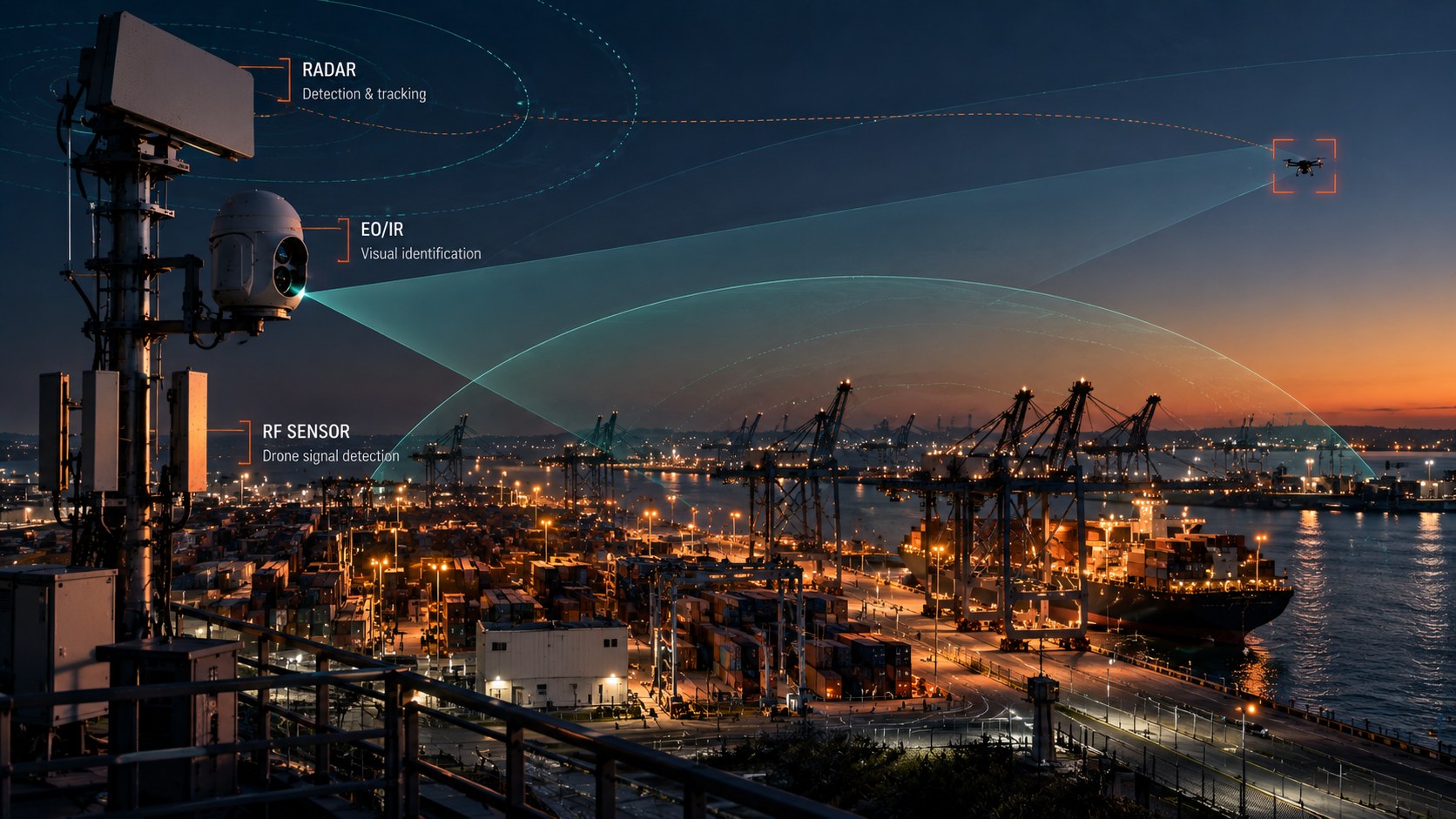
Radar can detect and track airborne objects through reflected radio signals. Its effectiveness depends on factors including target characteristics, surrounding clutter and system configuration.
RF detection can identify certain communications associated with unmanned aircraft, providing valuable complementary information. However, not all drones transmit signals detectable by a given RF system.
Electro-optical and infrared cameras can support visual observation and classification, but their performance depends on visibility, viewing geometry, atmospheric conditions and imaging capabilities.
These technologies become more useful when their information can be correlated.
For example, a radar track may direct a camera towards an object requiring verification, while RF information may help contextualise the observation.
The value of this approach is not simply deploying more sensors.
It is obtaining a more reliable operational picture from information that would otherwise remain fragmented.
The Critical Importance of Time
In aerial security, decisions often need to be made within a limited operational window.
A small drone may be detected relatively close to a sensitive area, leaving little time for verification and response.
A useful concept for evaluating security performance is the response margin: the time potentially available after accounting for detection, verification, decision-making and response activities.
This is not a fixed number.
It depends on the scenario, the environment, the quality of the information and the procedures available to the security team.
Improving detection range may increase the available time, but only if subsequent processes are efficient enough to use it.
A sophisticated detection architecture can still deliver limited operational value if alerts require extensive manual interpretation or if responsibilities are unclear.
This makes workflow design just as important as sensor selection.
Detection Does Not Automatically Authorise Neutralisation
One of the most important distinctions in Counter-UAS is the difference between detecting an airborne threat and taking measures to interfere with it.
Electronic countermeasures, interception and other forms of active mitigation can carry significant safety and legal implications.
In Europe, the authority to deploy or operate particular mitigation capabilities depends on applicable national legislation, operational circumstances and the organisation involved.
For many infrastructure operators, the practical priority is therefore to strengthen detection, verification, alerting and coordination with competent authorities.
A well-designed architecture should reflect these constraints from the beginning.
Technology must support an operational response framework that is both effective and lawful.
From Isolated Sensors to Coordinated Security
At Cybrid Thrust, our approach focuses on connecting detection technologies with operational requirements.
By bringing together radar, RF, EO/IR sensors and command-and-control platforms, we help organisations evaluate and integrate capabilities that contribute to situational awareness.
The objective is not to maximise the number of devices deployed around a facility.
It is to improve the quality and timeliness of information available to the people responsible for security decisions.
An effective Counter-UAS system should not merely tell operators that something is in the sky. It should help them understand what is happening, why it matters and what actions are available.
That is the difference between technology deployment and operational capability.
Strengthen Your Aerial Security Architecture
Are your detection technologies providing actionable information, or simply generating more alerts?
Cybrid Thrust supports critical infrastructure operators in assessing, selecting and integrating multi-sensor Counter-UAS capabilities.
Contact our team to discuss your operational requirements.
Contact our team