
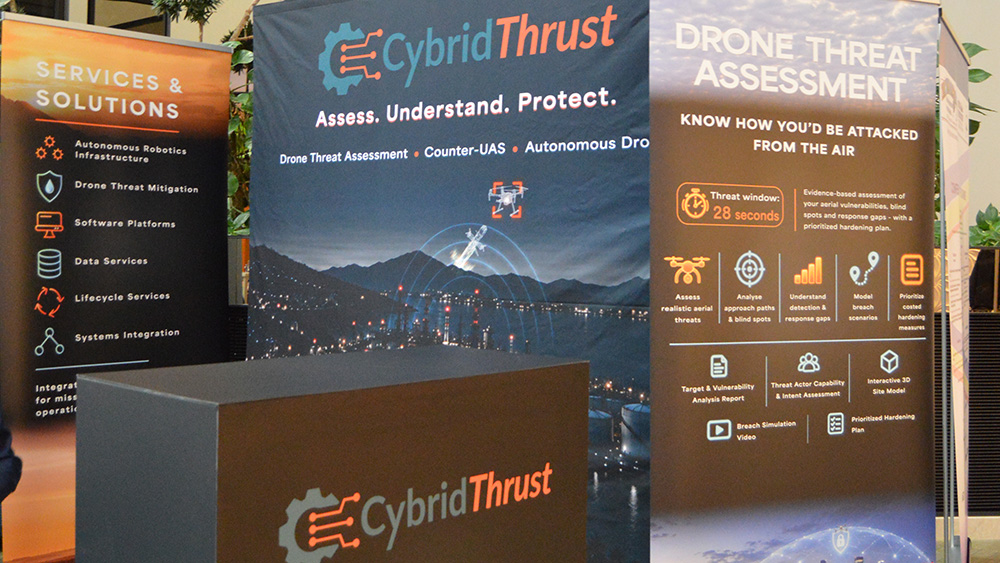
As Europe faces increasingly complex physical, cyber and hybrid threats, protecting critical infrastructure requires more than isolated security technologies. It demands a coordinated approach built on risk assessment, situational awareness, autonomous capabilities and operational resilience.
From 20 to 22 October 2026, Cybrid Thrust participated in Critical Infrastructure Protection & Resilience Europe (CIPRE 2026) in Brussels, joining infrastructure operators, security professionals, government representatives and technology providers to address one of Europe's most important security challenges: protecting the essential infrastructure on which modern societies depend.
Our participation reflects a fundamental conviction: effective infrastructure protection begins with understanding vulnerabilities and connecting the right technologies into a coherent operational capability.
Critical Infrastructure: An Increasingly Complex Security Environment
Energy production and distribution networks, airports, seaports, railway systems, telecommunications facilities, data centres and industrial installations form the backbone of Europe's economy and essential services.
Their disruption can have consequences extending far beyond an individual facility, affecting economic activity, public safety, supply chains and the continuity of essential operations.
At the same time, the threat environment is evolving.
Traditional physical security measures must now address a broader spectrum of risks, including unauthorised drone activity, aerial reconnaissance, sabotage, cyber-physical threats and coordinated disruptions.
These threats do not necessarily follow the boundaries of conventional security perimeters.
An infrastructure operator may have extensive ground surveillance, access control and CCTV coverage while remaining insufficiently prepared to detect or assess an approaching aerial threat.
This creates a fundamental challenge: a facility can be well protected at ground level while remaining exposed from the air.
The Emerging Aerial Security Challenge
The growing accessibility and capabilities of unmanned aerial systems (UAS) are changing the security landscape for critical infrastructure operators.
Drones provide significant benefits for inspection, monitoring, emergency response and operational efficiency. However, the same technological capabilities can also be exploited for unauthorised surveillance, reconnaissance or malicious activities.
The challenge is not limited to detecting a drone after it enters restricted airspace.
Security teams need to understand:
- Which aerial approach routes expose sensitive assets?
- Where do existing surveillance systems have detection gaps?
- How do terrain, infrastructure geometry and surrounding environments affect visibility?
- Which drone types and flight profiles represent credible risks?
- How much time is available between initial detection, threat verification and an operational response?
These questions illustrate why protecting infrastructure against aerial threats requires more than simply installing additional sensors.
Detection is only valuable when it provides actionable information early enough to support an appropriate response.
From Reactive Security to Risk-Based Protection
A recurring challenge in critical infrastructure security is the gap between technology deployment and an operational understanding of threats.
Security investments are sometimes driven by available products rather than by a structured assessment of vulnerabilities, operational priorities and realistic scenarios.
A more effective approach starts by examining the facility from a potential threat perspective.
This includes identifying critical assets, analysing surrounding terrain and possible aerial approaches, reviewing existing detection capabilities and evaluating operational response constraints.
At Cybrid Thrust, this principle underpins our Drone Threat Assessment approach.
By examining how a facility could be approached or observed from the air, organisations can identify vulnerabilities, assess detection limitations and compare potential protective measures before committing to major investments.
The objective is not to assume that every site requires the same technology.
It is to establish a clear understanding of risk and determine which capabilities are appropriate for the specific operational environment.
Assess. Understand. Compare. Decide.
Why Counter-UAS Requires a Multi-Layered Approach
No single counter-drone detection technology can provide complete visibility across every infrastructure environment and threat scenario.
Radar, radio-frequency detection and electro-optical or infrared sensors each contribute different capabilities, while also presenting technical and environmental limitations.
For example, terrain masking, infrastructure clutter, radio-frequency conditions and drone flight characteristics can influence detection and identification performance.
A robust Counter-UAS architecture therefore requires careful consideration of how different sensors complement one another.
Combining appropriate technologies can improve the ability to detect, track, classify and verify potential aerial threats.
However, successful integration requires more than connecting individual hardware components.
Sensor data must be correlated, presented in a meaningful operational context and integrated into existing security procedures.
Operators need a consistent picture of the situation, clear alert priorities and defined escalation processes.
The essential objective is to connect four operational functions:
Detect → Verify → Decide → Act
Each stage must be supported by suitable technologies, trained personnel and clearly established procedures.
Depending on the operational and regulatory context, response measures may involve observation, escalation to competent authorities, temporary operational restrictions or other legally authorised actions.
Autonomous Systems: Extending Security Beyond Fixed Infrastructure
While Counter-UAS technologies address aerial threat detection and assessment, autonomous systems can strengthen surveillance, situational awareness and infrastructure monitoring.
Autonomous drones and Drone-in-a-Box systems offer opportunities to extend security operations beyond the limitations of fixed camera installations.
Depending on the site configuration and applicable aviation requirements, these systems can support scheduled patrols, remote inspections, alarm verification and incident assessment.
Industrial robotics can provide complementary capabilities in environments where aerial operations are impractical or where persistent ground-level monitoring is required.
The value of autonomy lies not simply in reducing manual intervention, but in improving the availability and consistency of operational information.
For infrastructure operators, this can mean faster incident assessment, improved visibility over large or complex sites and more informed resource allocation.
However, deploying autonomous technologies effectively requires careful attention to cybersecurity, operational safety, reliability, communications and integration with existing security infrastructure.
Autonomy becomes valuable when it supports operational decisions—not when it operates as an isolated technology.
European Resilience: Connecting Physical Security, Cybersecurity and Operations
The importance of integrated infrastructure protection is also reflected in Europe's evolving regulatory framework.
The Critical Entities Resilience Directive (CER) strengthens the European approach to protecting essential services against physical and other disruptive risks, while the NIS2 Directive reinforces cybersecurity risk management and resilience across critical sectors.
Together, these frameworks underline the importance of understanding vulnerabilities, assessing risks and improving the ability of essential services to withstand and recover from disruptions.
For infrastructure operators, this reinforces a broader principle: physical protection, digital security and operational continuity cannot be treated as entirely separate disciplines.
An effective security strategy must account for the interdependencies between people, processes, technologies and infrastructure.
In this context, system interoperability and coordinated decision-making are not merely technical advantages.
They are essential components of operational resilience.
CIPRE 2026: Turning Technologies into Operational Capabilities
Our participation in CIPRE 2026 provided an opportunity to present Cybrid Thrust's approach to addressing these challenges.
At Stand 6 in Brussels, we highlighted three complementary capabilities:
- Drone Threat Assessment — Evaluating aerial exposure, identifying vulnerabilities and detection gaps, and supporting evidence-based security planning.
- Counter-UAS & Multi-Sensor Integration — Combining suitable detection technologies, surveillance capabilities and operational software to improve situational awareness and threat management.
- Autonomous Drones & Robotics — Supporting surveillance, inspection, incident verification and infrastructure operations through integrated autonomous systems.
These capabilities share a common objective: helping organisations move from individual technologies towards coordinated, practical and scalable operational solutions.
Building Resilience Starts with Understanding Risk
Critical infrastructure protection is not defined by the number of cameras, sensors or security platforms deployed.
It is defined by an organisation's ability to understand the threats it faces, recognise abnormal activity, make timely decisions and maintain essential operations under challenging conditions.
As technologies and threat scenarios continue to evolve, infrastructure operators will increasingly need solutions that are adaptable, interoperable and designed around operational realities.
At Cybrid Thrust, we believe that effective protection begins with a structured understanding of risk and continues through the careful integration of technologies, processes and expertise.
The future of critical infrastructure protection is not about deploying more isolated systems. It is about making existing and emerging capabilities work together.
Assess Your Infrastructure's Aerial Exposure
Is your organisation confident in its ability to detect, assess and respond to emerging aerial threats?
Cybrid Thrust supports infrastructure operators, industrial organisations and security stakeholders in assessing vulnerabilities, evaluating protective technologies and developing integrated security capabilities.
Explore our Drone Threat Assessment approach or contact our team to discuss your infrastructure protection challenges.
Discover our Drone Threat AssessmentContact Cybrid Thrust