Why the next challenge in critical infrastructure security is not collecting more information, but transforming fragmented data into operational intelligence.
The Growing Complexity of Modern Security Operations
Modern critical infrastructure facilities generate enormous amounts of information.
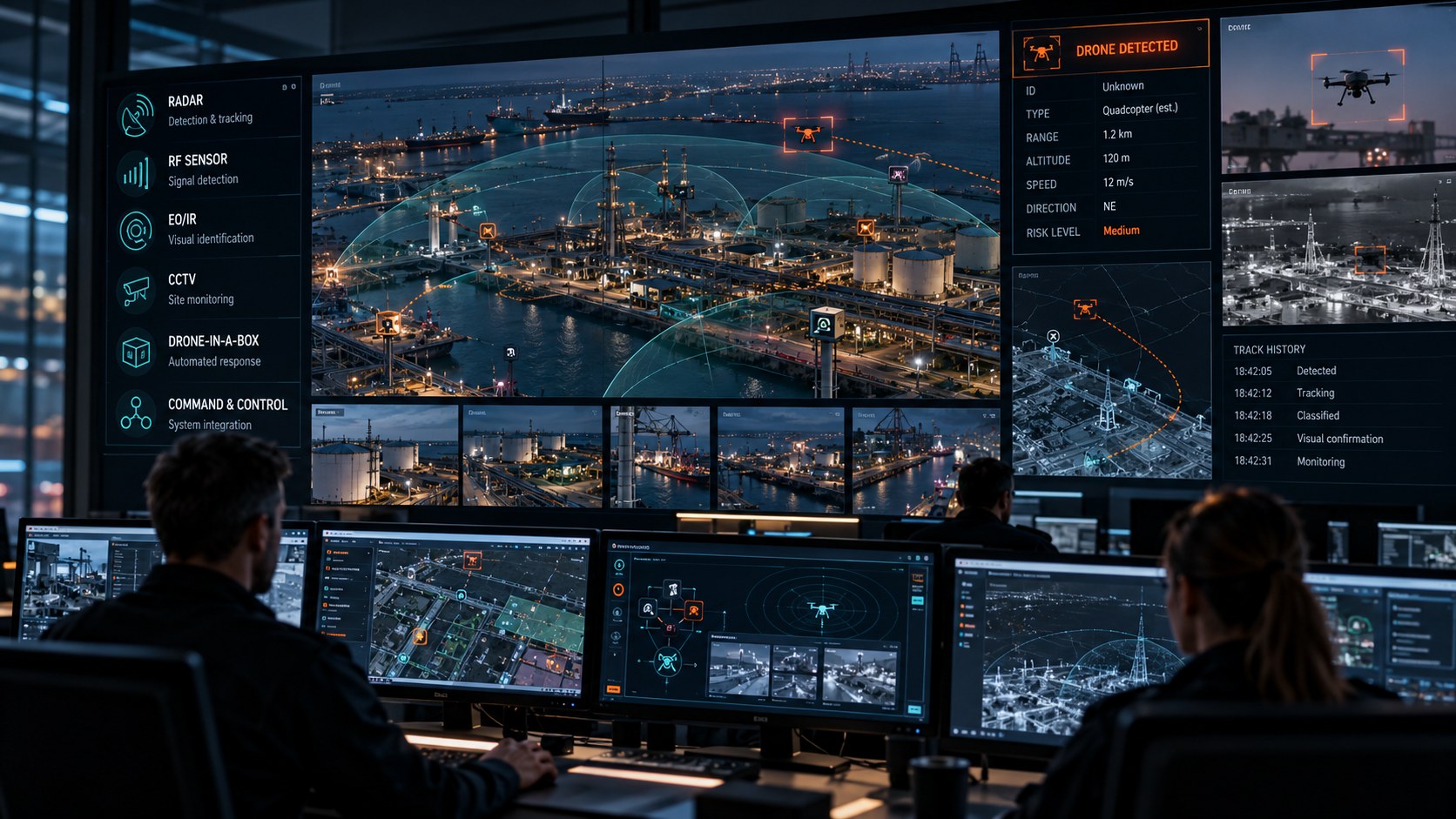
Surveillance cameras monitor physical perimeters. Radar systems track movement. RF sensors analyse the electromagnetic environment. Access control platforms record activity, while industrial monitoring systems continuously collect operational data.
Each technology contributes valuable information.
But as organisations deploy additional devices, a fundamental problem becomes increasingly apparent.
More information does not automatically lead to better decisions.
A security operations centre may receive alerts from several independent systems, each presenting its own interface, terminology and interpretation of events.
Operators are expected to understand what is happening, determine which alerts matter and coordinate an appropriate response.
The challenge is no longer simply obtaining information.
It is making that information useful.
When Technology Creates Information Silos
Consider an industrial facility equipped with a conventional CCTV network, perimeter intrusion detection and a newly installed drone detection system.
Each solution may perform its intended function effectively.
However, without suitable integration, the systems may operate independently.
An alert generated by the drone detection system may not automatically direct a camera towards the relevant area.
A security operator may need to consult several screens to determine whether multiple alerts relate to the same event.
The lack of correlation creates additional workload and may delay assessment.
This problem is not necessarily caused by inadequate technology.
It is often the consequence of fragmented system architecture.
Security technologies are frequently procured at different times, from different manufacturers, for different operational requirements.
Without a common integration strategy, each new system can add another layer of complexity.
From Isolated Sensors to a Shared Operational Picture
Sensor fusion and system integration aim to address this fragmentation.
The principle is to combine relevant information from different sources into a more coherent operational view.
In aerial security, radar data may provide information about an object's movement, while RF sensing may contribute information about associated communications.
Electro-optical or infrared cameras can offer additional observations to support classification or verification.
When appropriately integrated, these sources can help operators interpret an event more efficiently than isolated alerts.
However, combining data is not always straightforward.
Different systems may use incompatible communication protocols, coordinate systems, timestamps or data formats.
Successful integration requires the ability to align observations, manage uncertainty and distinguish between complementary and contradictory information.
The purpose of integration is not to display every available data point. It is to provide the information needed to understand a situation.
Where Artificial Intelligence Can Contribute
Artificial intelligence introduces additional opportunities for processing complex operational information.
Computer vision can support object detection and image analysis.
Machine learning can assist with classification, anomaly detection and the prioritisation of certain observations.
AI-based tools may also help operators navigate large volumes of historical data or identify patterns that would otherwise require extensive manual analysis.
However, AI should not be treated as a substitute for operational judgement.
A classification model may produce incorrect results. Sensor data may be incomplete, ambiguous or affected by environmental conditions.
For security-critical applications, it is essential that uncertainty remains visible and that important decisions can be traced to supporting information.
Human oversight, validation procedures and clear operational responsibilities remain necessary.
The objective is to reduce unnecessary complexity, not create an opaque decision-making process.
The Importance of Interoperability
A connected security architecture must work across technologies, manufacturers and operational environments.
This creates a strong argument for interoperability and vendor-neutral system design.
Organisations should consider whether new equipment can exchange useful information with existing infrastructure.
Relevant questions include:
- Can sensors communicate through documented interfaces or supported protocols?
- Can alerts be correlated with other operational events?
- Can the system integrate with existing command-and-control or security management platforms?
- Can information be recorded, reviewed and shared with authorised personnel?
- Can components be upgraded or replaced without redesigning the entire architecture?
These considerations influence long-term flexibility, maintenance costs and the ability to incorporate future technologies.
An effective architecture should not force an organisation to replace functioning systems simply to introduce a new capability.
Measuring Value Through Operational Outcomes
The effectiveness of an integrated security platform should not be measured exclusively by the number of devices connected.
More relevant indicators include the time needed to verify an alert, the workload associated with routine monitoring and the ability to maintain situational awareness during complex events.
Other useful measures may include alert quality, system availability and the consistency of operator workflows.
These metrics help determine whether technology integration is genuinely improving operational performance.
A connected system should make important information easier to find, interpret and act upon.
Turning Technology into Operational Capability
At Cybrid Thrust, system integration is central to our approach.
We connect autonomous platforms, sensors, Counter-UAS technologies and software capabilities with the operational environments in which they must function.
Our objective is to support architectures that are interoperable, maintainable and adapted to the requirements of each organisation.
The starting point is not the number of technologies available.
It is understanding what operators need to know and which decisions the system must support.
The future of critical infrastructure security will not be defined by the organisation collecting the most data. It will be defined by the organisation capable of turning reliable information into timely, informed decisions.
Connect Your Systems. Improve Your Operational Awareness.
Are your surveillance technologies working together, or operating as independent systems?
Cybrid Thrust helps organisations evaluate and integrate sensors, autonomous platforms and command-and-control technologies into coordinated operational architectures.
Contact our team to explore your system integration requirements.
Contact our team